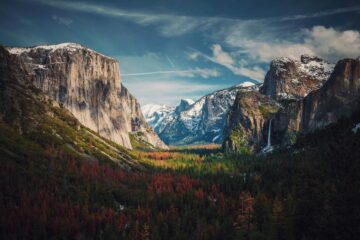
Yosemite National Park holds some of North America’s tallest waterfalls, but they do not all flow at the same time. This Yosemite waterfalls guide sorts out which falls are roaring, which are trickling, and which have gone dry, month by month, so a trip can be timed to the water rather than to guesswork. Most of the park’s famous falls are fed by Sierra snowmelt: spring is the season of thunder, late summer the season of thin ribbons and dry cliffs. The National Park Service waterfall guide is the authoritative source for flow seasons — worth checking before any trip. Use this Yosemite waterfalls guide to pick the month first, then the trail.
The short version: visit in May for the biggest water, and expect a very different, quieter park by August.
Yosemite Waterfalls Guide at a Glance
- Best month for peak flow: May, with June a close second.
- Falls that run all year: Bridalveil, Vernal, Nevada, Illilouette, Wapama, and Chilnualna.
- Falls that go dry: Yosemite Falls is often a trickle or dry by August; Sentinel and Ribbon typically end in June; Horsetail Fall flows roughly December through April.
- Easiest waterfall walk: Lower Yosemite Fall, a paved 1-mile loop that takes about 30 minutes.
- Best hike for waterfall lovers: The Mist Trail to Vernal Fall and Nevada Fall.
Yosemite Falls: The Tallest, and the First to Fade
At 2,425 feet, Yosemite Falls is one of the tallest waterfalls in the world and the most seasonal of the big-name falls. The National Park Service lists its flow as approximately November through July, with peak flow in May; by late July or August it is often dry through October, and the conditions page listed it as a trickle in late October 2026 — a surprise for summer visitors expecting a roaring fall.
The fall is actually three drops — Upper Yosemite Fall at 1,430 feet, the middle cascades at 675 feet, and Lower Yosemite Fall at 320 feet — all visible from many valley viewpoints, with an ice cone building at the base of the upper fall in winter.
The easiest way to experience it is the Lower Yosemite Fall Trail, a paved 1-mile loop with about 50 feet of gain that takes roughly 30 minutes. The eastern side of the loop, from the shuttle stop to the base, is wheelchair accessible, and in spring and early summer, expect spray on the footbridge near the base. The strenuous all-day hike to the top is a separate undertaking for fit hikers with an early start.
Planning around this fall is where a Yosemite waterfalls guide earns its keep: if Yosemite Falls is the must-see, the trip belongs in April, May, or June, not August.
Bridalveil Fall: The Year-Round Welcome
Bridalveil Fall is often the first waterfall visitors see entering Yosemite Valley, and it is one of the most reliable falls in the park. It flows all year with peak flow in May; in spring it thunders, and the rest of the year it drifts gracefully over its 620-foot drop.
For visitors following this Yosemite waterfalls guide with limited time or limited mobility, Bridalveil is the safest bet: short trails reach the base in a few minutes from a signed parking lot on the way into the valley, one wheelchair accessible, with views also available from near the tunnels on Wawona Road and Big Oak Flat Road.
Vernal Fall and Nevada Fall: The Mist Trail Pair
Vernal Fall and Nevada Fall are the twin rewards of the Mist Trail, the hike this Yosemite waterfalls guide recommends most; both falls flow all year. Vernal Fall drops 317 feet and peaks in late May or June, though by mid- to late summer it narrows and can split into two or three streams. Nevada Fall, at 594 feet, also peaks in late May or June and holds its power longer into the summer.
The hike starts at Happy Isles (shuttle stop #16) in eastern Yosemite Valley. The National Park Service lists three natural turnarounds on its Vernal Fall and Nevada Fall trails page:
- Vernal Fall Footbridge: 1.6 miles round trip, 400 feet of gain, moderate, about 1 to 1.5 hours, with an excellent view of Vernal Fall from the bridge.
- Top of Vernal Fall: 2.4 miles round trip via the Mist Trail, 1,000 feet of gain, strenuous, about 3 hours, climbing more than 600 steep granite steps beside the fall; spring spray soaks everything.
- Top of Nevada Fall: 5.4 miles round trip via the Mist Trail, 2,000 feet of gain, strenuous, about 5 to 6 hours; the John Muir Trail offers a longer, gentler return for a loop.
Seasonal closures matter here: the lower Mist Trail closes in winter because of falling ice and rock, so hikers use the John Muir Trail instead, and the Park Service schedules periodic repair closures — check current conditions before setting out. Stay on the trail and behind railings, and never swim above the falls: Emerald Pool and Silver Apron look inviting on a hot day, but swimming there is illegal and dangerous because of the current.
The Seasonal Falls: Sentinel, Ribbon, and Horsetail
Some of the falls in this Yosemite waterfalls guide exist only for part of the year, and catching them is a matter of timing. Sentinel Fall, about 2,000 feet tall on the south side of the valley near Sentinel Rock, flows approximately March through June with peak flow in May, best seen from Southside Drive near Sentinel Beach Picnic Area or from across the valley at Leidig Meadow. Ribbon Fall, at 1,612 feet, also flows roughly March through June with a May peak, visible from the road just beyond the turn for Bridalveil Fall.
Horsetail Fall runs on a different calendar: it flows approximately December through April off the east side of El Capitan and is famous for the February firefall, when the setting sun can light the falling water orange in mid- to late February, best seen from just east of El Capitan with parking at the El Capitan picnic area. For timing, viewing areas, and firefall-week restrictions, see the Yosemite firefall guide.
Beyond the Valley: Wapama and Chilnualna
Two more year-round falls reward visitors willing to leave Yosemite Valley, and this Yosemite waterfalls guide includes them because both stay far quieter. Wapama Falls, at 1,400 feet in Hetch Hetchy Valley, flows all year with peak flow in May, visible from the parking lot at O’Shaughnessy Dam or reached by an uneven trail to near its base. Hetch Hetchy Road is open from sunrise to sunset and closes when snow is falling or forecast overnight — check current conditions before driving out. Chilnualna Falls, in Wawona, totals about 2,200 feet, flows all year with peak flow in May, and hides behind twists in the rock so the whole fall can never be seen at once — a steep trail to its top is the only way to see it. Illilouette Fall, at 370 feet with a late-May peak, is best seen from the Panorama Trail near Glacier Point; Glacier Point Road is generally open approximately late May through sometime in November.
Planning Your Yosemite Waterfalls Guide Trip: Months, Difficulty, and Flow
Best months, in order
May is the single best month for a Yosemite waterfalls guide trip: peak runoff typically happens in May or June, and in May the seasonal falls still run alongside the year-round ones. April and June are nearly as good, with strong flow and, in June, warming weather. July still offers solid flow on Vernal, Nevada, and Bridalveil, but Yosemite Falls is fading, and the seasonal falls are gone. August through October brings the quietest trails and the lowest water; Bridalveil, Vernal, and Nevada still flow, but Yosemite Falls is usually dry. November through February is the low-water season with winter bonuses: the ice cone at Yosemite Falls, frost on the falls, and Horsetail Fall’s February firefall window.
Trail difficulty at a glance
Easy walks include the Lower Yosemite Falls loop (1 mile, about 30 minutes) and the short Bridalveil Fall trails; the Vernal Fall Footbridge hike is moderate (1.6 miles round trip), while the climbs to the tops of Vernal and Nevada Falls and to Upper Yosemite Fall are strenuous. Families with small children will find the valley-floor walks most manageable; the guide to California destinations with a baby or toddler covers the Lower Yosemite Falls Trail as a stroller-friendly option.
Practical tips
Before any Yosemite waterfalls guide trip, check the Park Service’s current conditions page: Tioga Road and Glacier Point Road were temporarily closed due to snow in late October 2026, and winter closures are normal. The standard entrance pass costs $20 to $35 depending on how visitors arrive, is valid for seven consecutive days, and the park does not accept cash — check current fee details on the NPS fees page before arriving. Arrive early in spring and summer, when valley parking fills quickly, and use the free valley shuttle to reach trailheads. Wear shoes with good traction, carry water, and stay on established trails: rock around waterfalls is slick even when dry, and river currents are powerful. For an overnight trip, the Northern California camping guide covers Sierra and Lake Tahoe options within reach of the park.
Yosemite Waterfalls Guide FAQ
When is the best time to see Yosemite’s waterfalls?
May, with April and June close behind. Peak runoff typically happens in May or June, and seasonal falls like Sentinel and Ribbon only run into June.
Which Yosemite waterfalls flow all year?
Bridalveil, Vernal, Nevada, Illilouette, Wapama, and Chilnualna Falls flow all year, though all run much lower by late summer. Yosemite Falls, Sentinel Fall, and Ribbon Fall do not.
Can I see waterfalls in Yosemite without hiking?
Yes. Bridalveil and Ribbon Falls are visible from the road, Yosemite Falls is visible from many valley viewpoints, and the paved Lower Yosemite Fall loop is an easy 1-mile walk to the base.
How does this Yosemite waterfalls guide help with a winter visit?
Winter changes the question from how much water to which falls are running. Bridalveil, Vernal, and Nevada still flow, Yosemite Falls may show its ice cone, and mid- to late February brings the Horsetail Fall firefall window.
Conclusion
Timing is everything with Yosemite’s waterfalls. A May visit, the top pick of this Yosemite waterfalls guide, delivers the park at full volume, with Yosemite Falls thundering and the Mist Trail living up to its name. A late-summer visit trades water for quiet trails and still delivers Bridalveil, Vernal, and Nevada, and a winter visit offers ice, frost, and the February firefall. Use this Yosemite waterfalls guide to match the trip to the falls that matter most — and plan around the water, not just the calendar.